Ever wondered what various sectoral policies point to? Indian states have such a complex governance system and so many policies, let us look at a select few for two states in India (one highly urbanised and the other being one of the least urbanised). We will also understand the steps if somebody wants to have access to land to setup a project. There are links to policy details. Some may find it boring. Some may be extremely interested. Mind it. This chapter is part of a series on Hierarchical Spatial Planning Framework
The presence of complex governance systems with multiple sectoral departments means that each departments is in-charge of various development measures. It is highly likely that each department has specific policies or other forms of guiding documents for planning interventions. Some of these policies/guiding documents are expected to directly have an impact on land use, whereas some of them would result in planning processes that affect eventual land use (indirect impact on land use). As most of the departments have such policies in force and decisions are made abiding by these documents, it is important to understand and consider them during the formulation of the land use planning policy for any state or country.
Generally, most state governments in India believe that planning, evaluation and statistical services are essential for planning growth and development. Hence, there is a specific focus on preparation of policies for each department and its regular updating based on monitoring and reviewing expenditure in state plan schemes for better governance of the State. In most states the planning and development department or the planning and convergence department (like the case of Odisha in GIZ project) tend to play a pivotal role in creating convergence between these policies and budgetary allocations as part of the overall governance in the State.
Some states have had a specific focus on preparation of five-year plans (mid-term vision planning) and monitoring and reviewing expenditure in State plan schemes for better governance of the State. These services may be rendered by the department’s viz., State Planning Commission (SPC), Department of Evaluation and Applied Research (DEAR) and Department of Economic and Statistics (DOES). The Planning Development and Special Initiative Department effectively anchors this pivotal role in the State of Tamil Nadu (in case of the GIZ project).
In Tamil Nadu, State Planning Commission is the nodal agency for planning in the State. It functions as an advisory body and recommends strategies and programs to the Government on various matters pertaining to the development aspects of the State. However, the State Planning Commission was lastly reconstituted on July 02, 2011.
In Tamil Nadu, the SPC initiated preparation of the Twelfth Five Year Plan for the plan period of 2012-2017, by constituting 15 Steering Committees and 47 Working Groups. These working groups and steering committees conducted discussion about current situation, problems, constraints, possible solutions and strategies. Draft approach papers were prepared for eliciting views and suggestions from various stakeholders. Apart from this, five regional consultation meetings were also conducted in Coimbatore, Madurai, Tirunelveli, Trichy and Cuddalore. The views and suggestions obtained from all stakeholders and working group reports became a base for preparation of sectoral chapters for the Twelfth Five Year Plan of the state. In addition, the services of consultants and professional institutions were also obtained to enhance the quality and content of the document.
The five-year plan provides for a guiding document for the state government. Each department then prepares an annual policy note in line with the plan outlay to ascertain that the governance is in line with the long-term vision.
Additionally, many state governments in India have prepared a compendium of projects that can be developed over a ten-year period. Whereas, in most states, sectoral departments have also created their own set of policies that guide them over a longer term say ten years.
As part of the project with GIZ, key polices were collected and analysed. Observations were noted down along with major points to ponder for future discussions. Key questions were also identified for understanding policy implications on other sectors and overall macro-economic scenario. Click here and here to access the base line document – Approach to Formulation of Land Use Planning Policy for Odisha and Tamil Nadu
Baseline of Sectoral Policies in Odisha
The following sectors and related policies were analysed for the baseline before approaching the departments for detailed consultations. Click here to read the detailed analysis.
- Agriculture and Allied
- State Agriculture Policy
- Draft Biotechnology Policy
- Policy Guidelines for raising Energy Plantations and Bio-Diesel Production
- Settlements
- Modified Area Development Approach
- Dispersed Tribal Development Project
- Comprehensive Development Plan, Land and Implementation Policy
- Activity Report of Housing and Urban Development Department
- Rural Development Policy
- Mahatma Gandhi National Rural Employment Guarantee Scheme
- Fisheries
- Perspective Plan for Management and Development of Fisheries
- Odisha Fisheries Policy
- Waterbodies
- State Water Policy
- Odisha State Urban Water Supply Policy
- Industries and Mines
- Industries Policy Resolution
- Information Communication and Technology Policy
- Strategic Roadmap for development of Electronics System Design and Manufacturing Sector in Odisha
- Odisha Draft Start up Policy
- Policy for Special Economic Zones
- Odisha MSME Development Policy
- Odisha Food Processing Policy
- Odisha Biotechnology Policy
- Infrastructure
- Odisha Port Policy
- Draft Infrastructure Policy
- Odisha Renewable Energy Policy
- Odisha State Road Project
- Odisha State Highway Development Programme
- Special Assistance for Vijaywada-Ranchi Corridor
- Forests
- Draft Odisha State Forest Policy
- Odisha Forest Vision (2020)
- Disaster Risk Reduction
- Integrated Coastal Zone Management Project
- Tourism
- Odisha Tourism Policy
- Ecotourism Policy
Baseline of Sectoral Policies in Tamil Nadu
The 12th Five-Year Plan (2012-17) of Tamil Nadu was analysed in detail for each of the following sectors. Click here to read the detailed analysis.
- Agriculture and Allied
- Settlements
- Governance
- Waterbodies
- Industries and Mines
- Infrastructure
- Forests
- Disaster Risk Reduction
The Land Acquisition Process
Ever wondered?
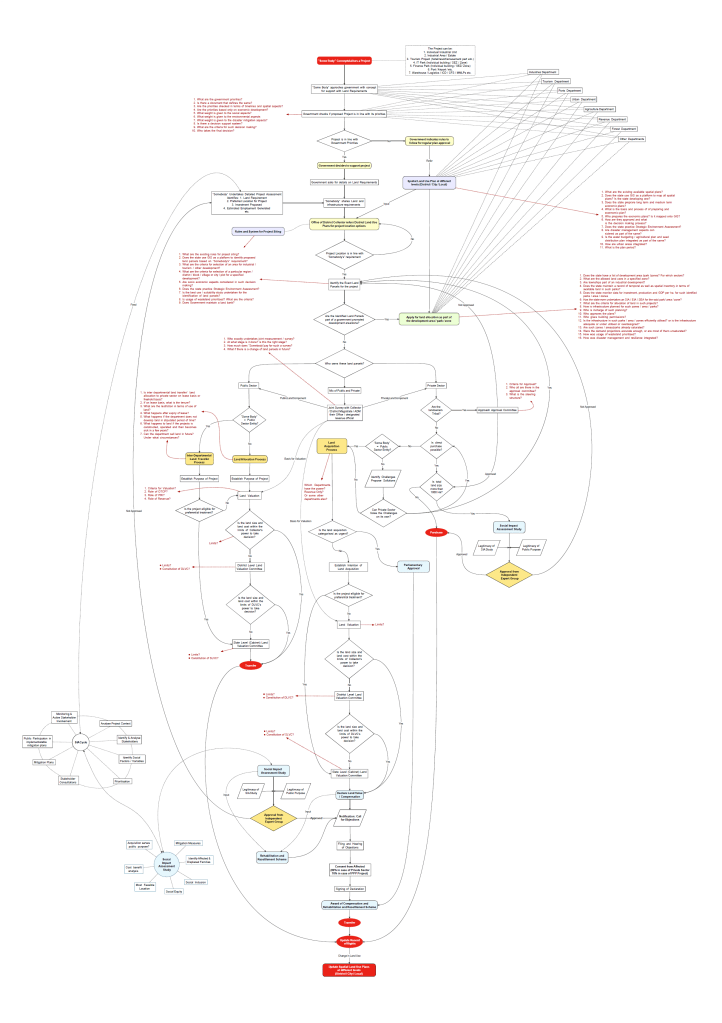
If you, or me, or ‘somebody’ wants to setup a project. The project maybe an industrial unit/estate or and tourism facility/park or IT park/SEZ or any logistics project etc. and any similar investment. Whom should you approach? What could be the process? Who decides? What decisions can be made at what level? Does the government have a plan? What if, somebody gets stuck in the process? Where all can somebody get stuck? How can you bring in efficiency in the process?
Check out the image below. The questions one should ask, while preparing a land use planning policy are highlighted in red. Click here to access the more readable portable document format (pdf) version of the mind map for acquisition process.
We have a good understanding of the departments; land uses and their policies by now. I guess it is time to start analysing the relationship between departments and various land use themes. Click here to read about department versus land use theme matrix.
 tarksthal - तर्कस्थल
2 thoughts on “Chapter 10: Sectoral Policies and the Land Acquisition Process”