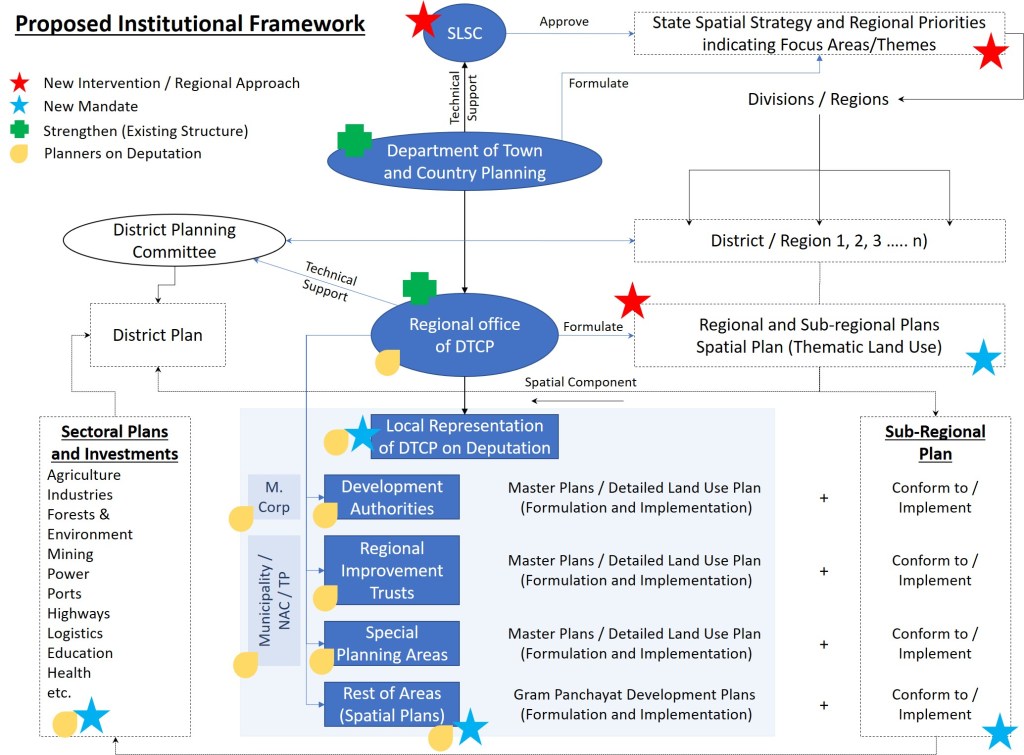
A policy can never be complete, if it does not provide for the institutional mechanism and implementation framework along with the timelines. Let us have a look at the new interventions, new mandate, what all structures we need to strengthen and where all planners are required. This chapter is part of a series on Hierarchical Spatial Planning Framework
A State spatial strategy gives impetus to economic growth through urbanization, industrialization as well as many aspects of agriculture and focussed irrigation investments while balancing the environment and social aspects. To facilitate the same, most states need to further strengthen and integrate spatial dimensions in the development process.
Preparation and implementation of spatial plans requires specialized scientific skills addressing each sector and level of governance. Whereas, the State Planning Commission and/or Planning, Development and Convergence Departments in the most states have been instrumental in multi-sectoral coordination, spatial planning has not been an integral component except for in Himachal Pradesh.
Furthermore, most states are developing an integrated state spatial data mapping infrastructure as a ‘Geo Portal’ (Web-GIS based system) through support of National Informatics Centre, Government of India and Electronics and Information Technology Department of the state along with the respective Remote-sensing and Space Application Centre.
The Department or Directorate of Town Planning (part of Housing and Urban Development Department in most states except for Himachal Pradesh) has been instrumental in preparing Master Plans for various urban settlements in the state. In few areas, the Development Authorities are preparing their own Master Plans.
All states in India need to further strengthen the three-tier hierarchical spatial framework for effective implementation of spatial strategies and efficiency of economic planning. The institutional mechanism for the Hierarchical Planning Framework may be as under:
State Level Steering Committee (SLSC)
For the purposes of (a) formulating and reviewing State Spatial Strategy Plan, (b) coordinating inter-sectoral interactions and priorities, (c) identifying planning regions in the state, (d) evaluation, approval, monitoring and review of regional plans and € management and governance of land uses in the state as detailed in the Guidelines, a State Level Steering Committee (SLSC) should be constituted.
The Department of Town and Country Planning the states web GIS Platform / Geo-Portal should support as the technical and advisory arm of the SLSC.
The state level steering committee may have the following structure (indicative only):
| Sr. No. | Designation | Department | Role |
| 1 | Chief Secretary | State Government | Chairperson |
| 2 | Secretary | Planning, Development and Convergence Department | Co-Chair |
| 3 | Secretary | Housing and Urban Development Department | Member |
| 4 | Secretary | Revenue and Disaster Management Department | Member |
| 5 | Secretary | Rural Development and Panchayati Raj Department | Member |
| 6 | Secretary | Forest and Environment Department | Member |
| 7 | Secretary | Industries Department | Member |
| 8 | Secretary | Steels and Mines Department | Member |
| 9 | Secretary | Agriculture Department | Member |
| 10 | Secretary | Water Resources Department | Member |
| 11 | Secretary | Tourism Department | Member |
| 12 | Secretary | Information Technology Department | Member |
| 13 | Secretary | Tribal Welfare Department | Member |
| 14 | Secretary | Finance Department | Member |
| 15 | Director | Department of Town and Country Planning | Member Convener |
Depending on the requirement, senior level representatives from other departments of the state government may be invited in the meetings of Steering Committee on case to case basis. An indicative list of such special invitee departments for meetings of the Steering Committee is mentioned below:
| Sr. No | Departments (Indicative, not limited to) |
|---|---|
| 1 | Department of Fisheries, Animal Resources Development |
| 2 | Department of Commerce and Transport |
| 3 | Department of Science and Technology |
| 4 | Department of Micro, Small and Medium Enterprises |
| 5 | Department of Skill Development and Technical Education |
| 6 | Department of Civil Aviation |
| 7 | Department of Energy |
| 8 | Department of Health and Family Welfare |
| 9 | Department of Education |
| 10 | Public Works Department |
| 11 | Department of Handlooms, Textiles and Handicrafts |
Department of Town and Country Planning
The Department / Directorate of Town and Country Planning is currently limited to preparation of spatial plans within notified planning areas only in many states. This is primarily because it is a subset of Housing and Urban Development Department in almost all states (except Himachal Pradesh) With an absence of functions and powers ensuring for regional spatial planning, efficiency of the department / directorate for ensuring synchronisation between master plans for different locations is affected immensely.
States should consider converting the ‘Directorate of Town Planning’ or ‘Directorate of Town and Country Planning’ to Department of Town and Country Planning (DTCP) and devolve it with the powers and functions to undertake all spatial planning activities in the state irrespective of urban, rural, industrial, etc. areas across the state.
The Department of Town and Country Planning (DTCP) should ideally be an independent department and/or a department under the State Planning, Development and Convergence Department.
As part of its new role, the Department of Town and Country Planning (DTCP) should be responsible for (a) preparing, implementing and monitoring the Regional and Sub Regional Plans (spatial planning strategy for each of the identified regions) (b) coordinating inter-sectoral interactions and priorities at regional level, (c) identifying Development Priority Zones, Preservation and Conservation Zones, Rural and Agricultural Zones, and Transitions Zones, within the region (d) formulating region specific Development Control Guidelines and Building Regulations € evaluating, approving, monitoring and reviewing the preparation and implementation settlement level plans within its jurisdiction (f) preparing settlement level plans for select areas on case to case basis.
The Department of Town and Country Planning (DTCP) should undertake all necessary activities through its Regional Planning Offices. High quality workstations and high-speed internet access to Geo Portals / Web GIS Platforms should be provided. Provisions for necessary financial, technical and human resources should be ensured in all future budgetary allocations.
Furthermore, the spatial planning professionals should be recruited only in the Department of Town and Country Planning. Their presence in local authorities, offices of local self-governance, and/or other sectoral departments like forest, agriculture, mining, industries, urban, rural etc. should be ensured on deputation to an exclusive cell on need/requirement basis. Furthermore, the positions should be transferable with compulsory transfers every 3-5 years, to give them better exposure and opportunities of growth.
Settlement Level Land Use Plans
For each settlement within the development priority zones and/or the existing planning areas, the respective development authorities should be responsible for (a) preparing, implementing and monitoring the master plans or development plans for respective jurisdictions (b) coordinating inter-sectoral interactions and priorities at settlement level, (c) formulating settlement specific Development Control Guidelines and Building Regulations (if necessary) (d) preparing local area plans, improvement schemes etc. along with and infrastructure and city investment plans within settlements.
For settlements outside the Development Priority Zones or notified Planning Areas, the Master Plans and/or Development Plans and/or Gram Panchayat Development Plans should be prepared either by the regional office of Department of Town and Country Planning (DTCP) or a New Development Authority or other relevant government department (Industries, Panchayati Raj etc.)
For all areas falling within the jurisdiction of Forest Department, the Forest Management and Conservation plan or other relevant plans may be prepared by the Forest Department.
The presence of spatial planning professionals in local authorities, offices of local self-governance, and/or other sectoral departments like forest, agriculture, mining, industries, urban, rural etc. should be ensured by their deputation to an exclusive cell on need/requirement basis from the Department of Town and Country Planning.
Formulation, Implementation and Review of Plans
For a more robust formulation, implementation, and review of plans, involvement of more than one individual agency or department should be ensured as follows:
| Plan Hierarchy | Plan Formulation | Plan Approval | Plan Implementation | Monitoring and Evaluation |
|---|---|---|---|---|
| State Spatial Strategy Plan | DTCP | SLSC | Sectoral Departments | SLSC with support from DTCP |
| Regional and Sub-Regional Plan | DTCP through regional offices | SLSC and/or DTCP | DTCP/ Sectoral Departments / District Administration | Planning, Development and Convergence |
| Master Plan for Development Priority Zones | Development Authorities / DTCP through local offices | DTCP | Development Authorities / ULBs / Gram Panchayats / Panchayati Raj / Industries/ other sectoral departments | DTCP / H&UD / District Administration / Independent Auditor / Social Audit |
| Master Plan for Rurban Areas | Development Authorities / DTCP through local offices | DTCP through regional offices | Development Authorities / Gram Panchayats / Panchayati Raj | Panchayati Raj / District Administration / Independent Auditor / Social Audit |
| Gram Panchayat Development Plan | DTCP through local offices | DTCP through regional offices | Gram Panchayats / Panchayati Raj / DRDA and other sectoral departments | Panchayati Raj / District Administration / Independent Auditor / Social Audit |
| Master Plan for Preservation and Conservation Areas | Forest and Environment for Forest Areas DTCP through local offices for non-forest areas | F&E / MoEF&CC DTCP through regional offices | F&E/ JFM/ PR/ H&UD / ULBs/ Gram Panchayats / PWD and other sectoral departments | District Administration / Independent Auditor / Social Audit |
| Master Plan for Transition and Buffer Zones | F&E for Forest areas DTCP through local offices for non-forest areas | F&E / MoEF&CC DTCP through regional offices | F&E/ JFM/ PR/ H&UD/ ULBs/ Gram Panchayats / PWD and other sectoral departments | District Administration / Independent Auditor / Social Audit |
| Detailed Development Plans within Master Plans | Development Authorities / Sectoral Departments | DTCP through local offices | ULBs / Gram Panchayats and other sectoral departments | Sectoral Department/ Independent Auditor / Social Audit |
Monitoring and Evaluation of Plans
All plans should be prepared on Open Geospatial Standard web-friendly GIS platform for easy monitoring of projects. The plans should be integrated with the State Spatial Data Infrastructure (the Geo-Portal) for regular monitoring and evaluation by SLSC or offices of DTCP. Respective sectoral departments should be provided with access to view the plans. Field level verifications should be conducted as and when necessary.
In addition to the concurrent evaluation undertaken by the hierarchical spatial framework, the impact evaluation for plans should be undertaken every 5 years through social audit and/or independent external evaluator/agency.
Spatial Budgeting
Spatial budgeting on a GIS platform can enable successful plan implementation and easier monitoring. Progress should be monitored on quarterly, half yearly and annual basis synchronizing with the fiscal and physical budget over space. The synchronisation of fiscal budget with spatial priorities should be undertaken by following agencies:
| Levels of Plans | Spatial Priority Areas to be identified by | Synchronisation with the fiscal Budget of | Reporting to be done to |
|---|---|---|---|
| State Spatial Strategy Plan | SLSC | State and Sectoral Departments | SLSC |
| Regional and Sub-Regional Plans | DTCP in discussion with sectoral departments and District Authorities/ District Planning Committee | District Administration & State Level Sectoral Departments | Planning, Development and Convergence Department |
| Settlement Level Plans | Development Authorities / Urban and Rural Local Bodies as per the Master Plan, Sectoral departments like forests, Industries, agriculture, etc. | Local Administration / District Planning Committee / District Level Sectoral Department Offices | District Collector and District Planning Committee |
Public Participation and Awareness Generation
In addition to the provisions of respective State Town and Country Planning Acts and recommendation of URDPFI and RADPFI Guidelines, stakeholder participation and public involvement from starting of planning process should be encouraged. The plans should be uploaded for objections and suggestions giving appropriate time for comments on the website of Department of Town and Country Planning as well as respective planning authorities in English along with local languages, dialect and script if necessary. Respective portions of all hierarchical plans should be permanently displayed for public view at all government offices including urban and/or rural local body offices to spread the message of plans.
Human Resources and Capacity Development
State Urban Development Agency (SUDA) and State Institute for Rural Development and Panchayati Raj (SIRD&PR) should jointly evolve a capacity development programme and setup a calendar schedule for regular trainings and capacity development of planners and other involved department officials from various sectors in the state for the purpose of making these plans.
All states should build capacity of existing state universities in developing Urban and Regional Planning Courses to train students to be future planners.
Timelines
| Plan Hierarchy | Short Term (3 years) | Medium Term (7 years) | Long term (15 years) |
|---|---|---|---|
| State | – Approve State Land Use (Planning) Policy – Set up SLSC – Strengthen DTCP -Approve State Spatial Strategy Plan – Initiate Spatial Budgeting | – First Review and updating of State Spatial Strategy Plan – Standardised GIS database and convergence – Regular capacity building – Rolling Spatial Budgeting | – Second Review and updating of State Spatial Strategy Plan – First Impact Evaluation – Regular capacity building programme – Rolling Spatial Budgeting |
| Region and Sub Regions | – Regional and Sub Regional Plans for Urbanisation Corridors, City Regions, and their districts – Initiate Spatial Budgeting – Initiate capacity building | – Regional plans for Growth Centres and their districts – First Review and updating of Regional and Sub Regional Plans – Standardised GIS database and convergence – Regular capacity building – Rolling Spatial Budgeting | – Regular Review and updating of Regional and Sub Regional Plans – First Impact Evaluation – Regular capacity building programme – Rolling Spatial Budgeting |
| Settlement / Local Level | – Master Plans for DPZs districts with regional plans – Master Plans for Priority Preservation and Conservation Zones – Master Plans for all Rurban Clusters – Initiate Master Plans for Transition and Buffer Zones – Initiate Spatial Budgeting – Initiate capacity building | – Master Plans for all DPZs – Master Plans for all Preservation and Conservation Zones – Master Plans for all Transition and Buffer Zones – Initiate Master Plans for Rural Settlements – First Review and update of Master Plans – Standardised GIS database and convergence – Rolling Spatial Budgeting – Regular capacity building programme | – Master Plans for all Rural Settlements – Regular Review and update of Master Plans – First Impact Evaluation – Regular capacity building programme – Rolling Spatial Budgeting |
And this how we completed the first three years of conceptualising, energizing, strengthening the Hierarchical Spatial Planning Framework in India.
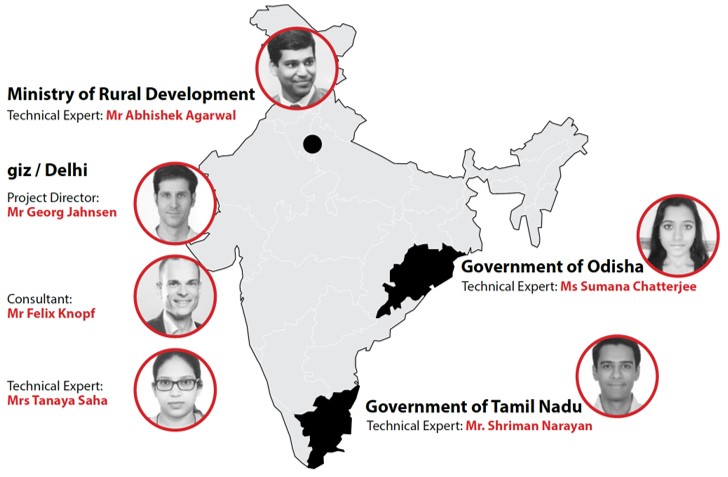
We ended the case projects with a detailed policy proposal for each states (yet to accepted/approved), one case sample for each state at regional level and its linkages to sub-regional and settlement level planning, setting the stage for capacity building with initial trainings and lots and lots of documentation for standardisation and awareness generation / sensitization.
Click here to access the draft policy proposals for Odisha and Tamil Nadu
Click here to access the demonstration projects for regional and settlement level plans in Odisha
Click here to access the demonstration projects for regional and sub-regional plans in Tamil Nadu
Click here to access the Human Capacity Building Measures undertaken as part of the project
Click here to access the Standardisations suggested for Regional Spatial Planning as part of the project.
Click here for documentation of various workshops, conferences, dialogues and research presentation and documentations for building a culture of spatial planning.
Thank you for reading through. Remember. Cooperation is Teamwork.
Click here to go back to main page
 tarksthal - तर्कस्थल
One thought on “Chapter 19: Institutional Mechanism, Implementation Framework and Timelines”