Tag Archives: Hierarchical Spatial Planning

Chapter 05: Land and Sustainable Development Goals (SDG)

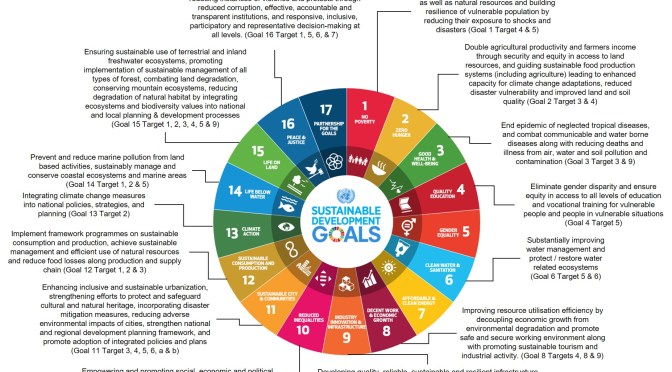
Who imagined that one policy has the potential to impact 14 goals and 37 targets? This chapter is part of a series on Hierarchical Spatial Planning Framework

Addressing issues pertaining to land through spatial and land use planning would substantially further the 2030 Global Agenda for Sustainable Development. A land use planning policy (if prepared) has a potential to positively impact achievement of 14 out of the 17 Sustainable Development Goals (SDG) due to its direct relation to 37 targets spread across SDG 1, 2, 3, 4, 6, 8, 9, 10, 11, 12, 13, 14, 15 and 16.

Continue reading Chapter 05: Land and Sustainable Development Goals (SDG)

Chapter 06: Approach to Policy Formulation

We visualise the approach to policy formulation, as we understand the concepts of cooperation planning and strategy, the importance of research, baseline and benchmarking, and are introduced to the concepts of working groups, consultations, documentation. This chapter is part of a series on Hierarchical Spatial Planning Framework

Governments primarily use spatial and land use plans and environmental and building code regulations to affect land use. These instruments function by restricting usage of land but cannot influence how individuals and businesses would like to use land. Many other policies or schemes and planning procedures, which are not causally related to land use planning systems, create incentives to use land in certain specific ways. It is not necessary that such policies correspond to the objectives of land use planning systems.

Continue reading Chapter 06: Approach to Policy Formulation

Chapter 07: Stakeholders and Actors – the Departments, their Roles and Mandates

We understand the concept of stakeholders and actors and look at possible stakeholders at National and state levels with two examples. This chapter is part of a series on Hierarchical Spatial Planning Framework

Who are the right stakeholders and actors? Are they on board and do they support the project? Are they open to the concept and willing to adapt? How important are they? Do they share common objectives? Do they have the right mandate? Are there some who are the key driving force whereas others who play a secondary role? Are there any veto players? Are all actors only from government, or are they from private sector and civil societies also?

Continue reading Chapter 07: Stakeholders and Actors – the Departments, their Roles and Mandates