Tag Archives: Hierarchical Spatial Planning

Chapter 14: Spatial Representations of Key Challenges

We are now well into the details for each sector. We have so much information on land use change and sectoral challenges. Let us spatially represent them and use the power of visualisation. We do this with two examples. This chapter is part of a series on Hierarchical Spatial Planning Framework

We have been working for the past 24 months now and undertaken an extensive study of our state. We have looked at the baseline scenario in terms of governance structure, department roles and their mandates, we have developed a good understanding of Land uses and its statistics for our state, we have also analysed the policies and strategies in detail.

Continue reading Chapter 14: Spatial Representations of Key Challenges
Chapter 15: The Hierarchical Spatial Planning Framework

Aha! The key essence of this series of articles. The objectives and introduction to proposed hierarchical spatial planning framework. And of course, links to details. This chapter is part of a series on Hierarchical Spatial Planning Framework

The key challenges as discussed in the previous chapter along with their spatial-temporal visualisation has enable us to understand the aim of a proposed policy. A proposed land use planning policy for a state in India should ideally aim to provide a strategic framework to spatial integration of environmental, economic, social development initiatives in the state. This framework should be addressable at all levels of governance, with a view to achieving sustainable growth, equitable access to resources and conflict-free land use management.

Continue reading Chapter 15: The Hierarchical Spatial Planning Framework

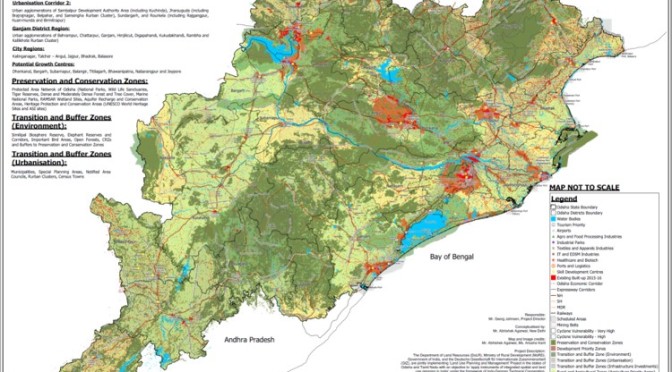
Chapter 16: State Spatial Strategy

We look at the evolution of state spatial strategies through the lens of the three pillars of sustainability i.e. environment, economy and society with two proposals/examples. We also get links to the details for of the two proposals. This chapter is part of a series on Hierarchical Spatial Planning Framework

For addressing the challenges and issues economic disparity, water constraints, or other sectoral conflicts and land use planning challenges as discussed earlier in Chapter 14, a state level spatial strategy can ensure that use of land is in general driven by its most economical and least environmental impact.

A state spatial strategy would ideally advocate assigning priority areas for economic development, no development as well as conservation and augmentation of water. This can improve economic competitiveness along with more equitable income distribution as compared to a scenario of continued water scarcity.

Continue reading Chapter 16: State Spatial Strategy