Tag Archives: Spatial Planning

Chapter 03: Flight to Urbanisation

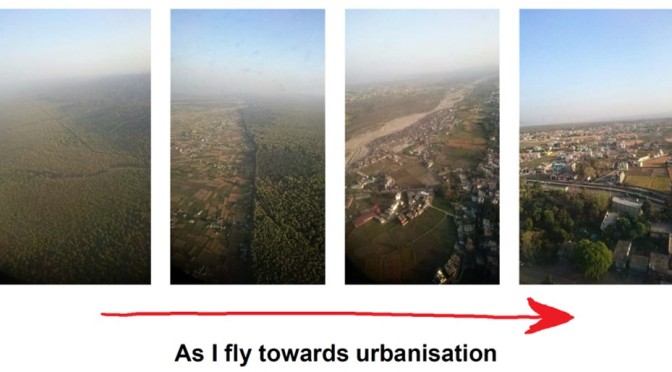
Book a window seat, board the plane to take the flight to urbanisation. You will see the land uses change below you. The birds eye view is the perfect introduction to the concept of levels of plans and scales. This chapter is part of a series on Hierarchical Spatial Planning Framework

Have you ever flown in an aircraft? If yes, which seat do you take, the window or an aisle? Personally, I always prefer the window seat. Not because of the lesser disturbance (that is an added advantage). But more because I really like to see the birds eye view of the changing land use and land cover. Especially during take-off and landings. Morning, noon, afternoon, evenings, or night. Does not matter. I just love the view. And yes, I call it ‘the flight to urbanisation’

Continue reading Chapter 03: Flight to Urbanisation
Chapter 04: Why Land Use Planning Policy?

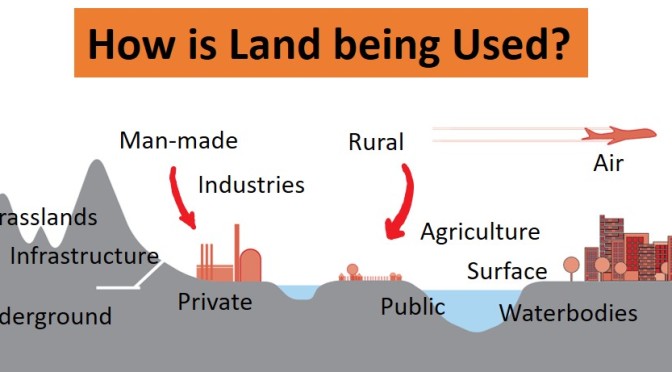
Visualise how land is being used globally, and the sectoral significance in terms forests, water, agriculture, settlements etc. We also look at how Constitution of India deals with Land and introduce ourselves to the relationship of spatial planning with different public policies. This chapter is part of a series on Hierarchical Spatial Planning Framework

“Climate change, population growth, rapid urbanisation, food insecurity and water scarcity – have increased competition for resources and heightened tensions and instability.”

António Guterres, Secretary General of the United Nations, while taking oath in 2017
Continue reading Chapter 04: Why Land Use Planning Policy?

Chapter 08: Land Use Categorisation

How many land use categories, sub-categories, classifications, definitions, can you think of? So many departments have their own definitions for different purposes. Let us try and bring it all together and learn the power of mind mapping tools in the process. This chapter is part of a series on Hierarchical Spatial Planning Framework

This chapter is specific to Indian scenario. Still, some sections might be relevant to other regions and countries as well.

The agriculture departments of various states in India have been maintaining land use statistics with a predominant focus on agriculture as a land use. These statistics have been maintained for long under a nine-fold classification as prescribed by Ministry of Agriculture, Government of India. Five of these nine categories are related to agriculture, one for forests, one for grazing & pasture lands, one for wasteland and one for all other non-agricultural land uses.

Continue reading Chapter 08: Land Use Categorisation