Tag Archives: Spatial Planning

Chapter 09: Land Use Statistics

What is the land utilisation pattern in India? Let us have a look and understand the sources of information for some key categories. This chapter is part of a series on Hierarchical Spatial Planning Framework

This chapter is specific to Indian scenario. Still, some sections might be relevant to other regions and countries as well.

Various ministries and departments at the National as well as the State Government maintain information on existing land use statistics for their own planning purposes. It is important to understand how these statistics look together at various levels of governance. Such a collation of land use statistics and envisaged/proposed plans is expected to give an interesting insight into the land use scenario for the state as well as the challenges ahead.

Continue reading Chapter 09: Land Use Statistics

Chapter 12: Working Group – Why and How?

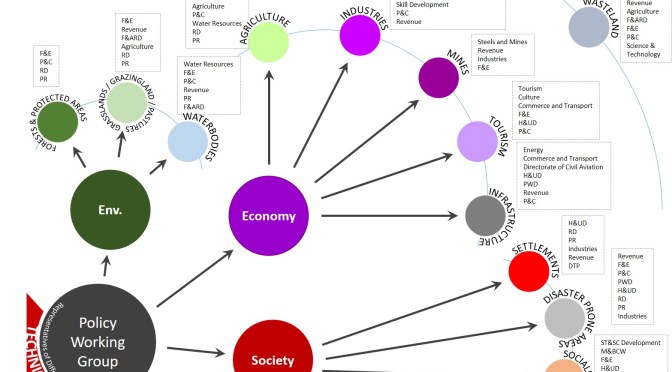
This is where we bring all the departments together. We setup the working group and define the agenda for each theme. This chapter is part of a series on Hierarchical Spatial Planning Framework

Whoa… We have come a long way. We have spent close to 15 months to come so far.

We are now aware and in agreement with the need of Hierarchical Spatial and Land Use Planning (Click here). We also agree on the significance of a state land use planning policy (Click here and here). We have also seen the importance of Cooperation strategy and the approach that we can adopt for preparing such a policy. (Click here).

Continue reading Chapter 12: Working Group – Why and How?

Chapter 13: Thematic Consultations

After setting the working group let us prepare and undertake the thematic consultations. We also document and extract outputs and outcomes from them in terms of visions and land use interaction matrix with an example. This chapter is part of a series on Hierarchical Spatial Planning Framework

We are nearing completion of month 18 now. It has been three months since we are sensitising every stakeholder department on their role and ownership for the policy. Fortunately, they all agree and are on board. Hopefully, we also have a formal government notification circulated to at core as well as extended working group members.

In short, we have already set up the working group. First battle won.

Continue reading Chapter 13: Thematic Consultations

Chapter 15: The Hierarchical Spatial Planning Framework

Aha! The key essence of this series of articles. The objectives and introduction to proposed hierarchical spatial planning framework. And of course, links to details. This chapter is part of a series on Hierarchical Spatial Planning Framework

The key challenges as discussed in the previous chapter along with their spatial-temporal visualisation has enable us to understand the aim of a proposed policy. A proposed land use planning policy for a state in India should ideally aim to provide a strategic framework to spatial integration of environmental, economic, social development initiatives in the state. This framework should be addressable at all levels of governance, with a view to achieving sustainable growth, equitable access to resources and conflict-free land use management.

Continue reading Chapter 15: The Hierarchical Spatial Planning Framework

Chapter 16: State Spatial Strategy

We look at the evolution of state spatial strategies through the lens of the three pillars of sustainability i.e. environment, economy and society with two proposals/examples. We also get links to the details for of the two proposals. This chapter is part of a series on Hierarchical Spatial Planning Framework

For addressing the challenges and issues economic disparity, water constraints, or other sectoral conflicts and land use planning challenges as discussed earlier in Chapter 14, a state level spatial strategy can ensure that use of land is in general driven by its most economical and least environmental impact.

A state spatial strategy would ideally advocate assigning priority areas for economic development, no development as well as conservation and augmentation of water. This can improve economic competitiveness along with more equitable income distribution as compared to a scenario of continued water scarcity.

Continue reading Chapter 16: State Spatial Strategy

Chapter 17: Framework for Regional Spatial Strategy and Planning

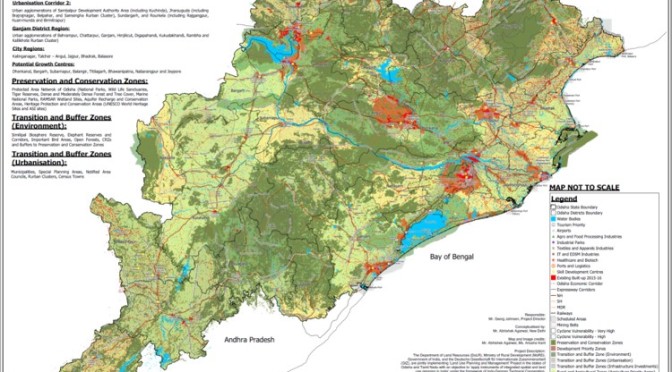
We investigate what a regional plan should have. What zones to create and what all to include in those zones. This chapter is part of a series on Hierarchical Spatial Planning Framework

Land use capacities have varied overtime with changing spatial environmental and economic conditions. This has necessitated identification of land use capacity for alternative choices of land allocation among various uses. It is increasingly necessary to delineate the problem areas, which need separate attention. Since supply of land is fixed, use of land for one purpose will be at the expense of other. When huge investments are made on land for one purpose it cannot/should not be reverted to other uses.

Continue reading Chapter 17: Framework for Regional Spatial Strategy and Planning

Chapter 01: Why are we discussing this?

A humorous learning process using various images, cartoons, and graphics circulating around on internet (of course I did not make any of these). This chapter is part of a series on Hierarchical Spatial Planning Framework

Have you ever come across following cartoons, graphics and images on the internet? They just pop up on google search as related images. (Of course, I did not make any of these).

Continue reading Chapter 01: Why are we discussing this?

Chapter 18: Framework for Settlement Level Land Use Plans

We quickly go through the essence of various well evolved settlement level land use plans and find relevant links to related guidelines. We also focus a bit on the guidelines for transition and buffer zones. This chapter is part of a series on Hierarchical Spatial Planning Framework

The Town and Country Planning Acts of most states provide for preparation of Development Plans, Master Plans, Zonal Plans, Local Area Plans, Detailed Development Plans, Town Planning schemes, improvement schemes etc. prepared at a scale 1:10,000 or higher indicating precise boundaries of various land uses at local level. Such plans and improvement schemes which are statutory plans and can be enforced at local/plot level.

Continue reading Chapter 18: Framework for Settlement Level Land Use Plans

Chapter 02: What is Land Use Planning and Management?

Construction of the concept of Land Use Planning and Management. This chapter lays emphasis on benefits of visualisation. This chapter is part of a series on Hierarchical Spatial Planning Framework

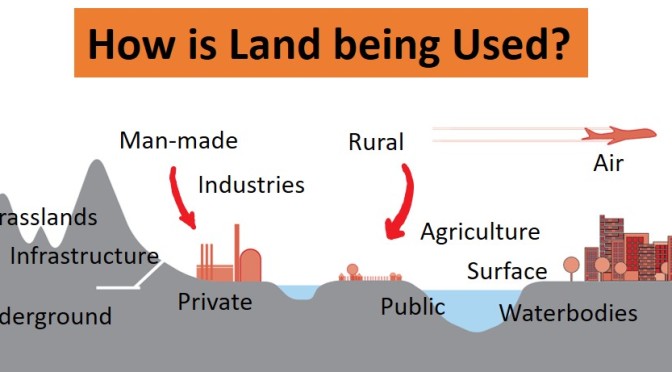
Land use planning and management is a complex word. It needs to be constructed step by step to create a better understanding.

Continue reading Chapter 02: What is Land Use Planning and Management?

Chapter 19: Institutional Mechanism, Implementation Framework and Timelines

A policy can never be complete, if it does not provide for the institutional mechanism and implementation framework along with the timelines. Let us have a look at the new interventions, new mandate, what all structures we need to strengthen and where all planners are required. This chapter is part of a series on Hierarchical Spatial Planning Framework

A State spatial strategy gives impetus to economic growth through urbanization, industrialization as well as many aspects of agriculture and focussed irrigation investments while balancing the environment and social aspects. To facilitate the same, most states need to further strengthen and integrate spatial dimensions in the development process.

Continue reading Chapter 19: Institutional Mechanism, Implementation Framework and Timelines