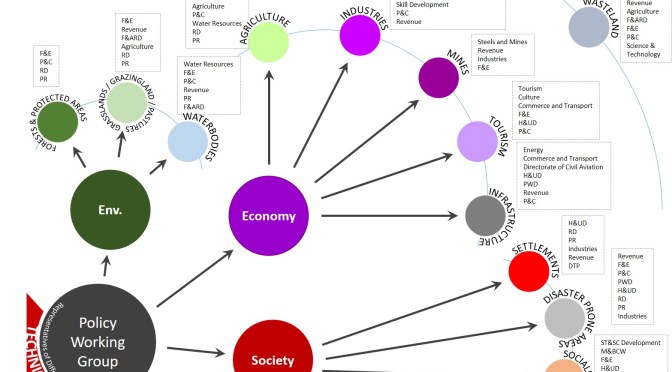
This is where we bring all the departments together. We setup the working group and define the agenda for each theme. This chapter is part of a series on Hierarchical Spatial Planning Framework
Whoa… We have come a long way. We have spent close to 15 months to come so far.
We are now aware and in agreement with the need of Hierarchical Spatial and Land Use Planning (Click here). We also agree on the significance of a state land use planning policy (Click here and here). We have also seen the importance of Cooperation strategy and the approach that we can adopt for preparing such a policy. (Click here).
We have also understood the details that need to be captured as part of the baseline assessment for policies (click here, here, here, here and here) and we have also looked at a benchmarking study (Click here).
Now the question is… what next? How do we bring all these departments together?
Read on…
The Working Group
The land use (planning) policy brings on board a multi-sectoral approach and ownership to ensure that the underlying themes/essence of various existing policies and guidelines of different sectors are captured and well represented in an overarching framework to ensure synergy across various sectors.
For achieving above mentioned purpose, formation of a multi-sectoral working group (involving multiple state sectoral departments) becomes necessary.
An academic expert panel for guiding and vetting the policies and other supporting/guiding documents would also be required. This academic panel along with the team that works together on the cooperation, that has prepared the documents so far. Let us call this team the Technical Support to the Working Group.
We have seen that there are a lot of stakeholders / actors here. Let us select some primary actor/stakeholders that have the maximum influence and veto power. Let us call this group of actors the Core Working group and all the other stakeholder departments extended working group.
The Core Working Group along with the Technical Support would essentially be responsible for coordination of the entire process including interactions with extended working group members and other stakeholder departments on theme basis.
Theme basis?
Remember? We are talking about sustainability here. And there are three core pillars of sustainability. Environment, Economy and Society.

Fine. Why wastelands?
Because, we want to do away with the category of wastelands eventually, by utilising it all under each one of the three pillars on case to case basis.
Functions of Core Working Group
Inter alia (among other things), functions of the core working group should include (but not limited to):
- Allocating time for meetings at regular intervals
- Ensuring Inter-departmental coordination and cooperation across the governance structure
- Take lead in facilitating theme/sub theme-based stakeholder consultations
- Finalising the scope of policy with due guidance from panel of academic experts
- Moderate each subtheme to assess gaps in existing provisions (policies, acts, rules and regulations)
- Facilitate data and information collection as necessary for the purpose of drafting the policy
- Enlist issues/concerns of land use practices, governance and management based on gap assessment, stakeholder interactions and guidance from panel of academic experts
- Record all stakeholder interaction and consultation meetings, workshops and circulate the same to attendees for inputs and finalisation
- Close coordination with Department of Town and Country Planning to create a broad framework guideline for hierarchical spatial and land use planning that can be integrated into the governance structure for the state and build consensus with other sectoral departments for the same
- Formulate policy drafts and the records and information as available with support from Technical Team
- Present and discuss draft policy to a State Level Steering Committee for review and inputs
- Revise and update the draft policy incorporating feedback from all stakeholders, departments, and the panel of academic experts to achieve consensus and eventual submission to the State for approval.
Composition of Working Group
It is suggested that the heads of various relevant sectoral divisions/departments should undertake the above-mentioned role. The core working group should ideally see a representation for following key departments:
- State Planning Commission
- Planning, Development & Convergence Department
- Department of Town and Country Planning
- Revenue & Land Administration Department
- Housing and Urban Development Department
- Rural Development & Panchayati Raj Department
- Forest & Environment Department
- Water Resources Department
- Disaster Management Department
The Technical Support
A dedicated team of professionals might be required to provide all necessary technical support through the entire process. Among other things, the support may be in the form of knowledge provision, research and information assessments, drafting of formats for data/information collection, usage and interpretation, drafting the policy, etc.
Such a team will have to further ensure:
- Allocating time for sensitisation and technical meetings with the core working group, panel of academic experts as well as other key stakeholders.
- Support core working group in ensuring Inter-departmental coordination and cooperation across the governance structure by providing out of box thinking, ideas and concepts
- Support core working group with a baseline information assessment, moderation as well as collation of information for ensuring successful theme/sub theme-based stakeholder consultations
- Close interaction and follow-ups with panel of academic experts including identifying them and bringing them on board
- Support core working group in assessing gaps in existing provisions (policies, acts, rules and regulations)
- Analyse enlisted issues/concerns of land use practices, governance and management based on gap assessment, stakeholder interactions and guidance from panel of academic experts
- Support core working group with formats for recording stakeholder interactions, consultation meetings, workshops and circulate the same to attendees for inputs and finalisation
- Support core working group in ensuring close coordination with Department of Town and Country Planning in creating a broad framework guideline for hierarchical spatial and land use planning that can be integrated into the governance structure for the state
- Support core working group in formulation of policy drafts
- Support core working group in presenting and discussing draft policy to the State level Steering committee for review and inputs
- Support core working group (if necessary) in undertaking revision and updates to the draft policy incorporating feedback from all stakeholders, departments, and the panel of academic experts to achieve consensus and eventual submission to the State for approval
Panel of Academic Experts
Knowledge support from the multi-disciplinary academic advisory panel should expected in terms of observations and recommendations on baseline, scope of policy and the draft policy itself. The panel of academic experts should ideally garner representations from various planning institutions/universities located in different states across the country to ensure incorporation of as varied experiences as possible.
The documents prepared by core working group through support of technical team should ideally be shared with the academic expert panel for their inputs, review and recommendations on the notes and short reports on theme/fortnightly/monthly basis.
Preferably some panel members should be identified and taken on board for research and whitepapers, as well as thematic consultations.
The academic panel should actively contribute and engage with the working group for
- Guidance and review of reports/working papers through e-mail/meetings
- Allocating time for select thematic consultations based on availability
- Review, assess and suggest improvements in draft policy papers and existing inter-departmental coordination and cooperation across the governance structure in the state
- Inputs for finalising the scope of policy in terms of outlining
- Gaps in existing provisions (policies) based on technical teams’ assessment
- Suitable assessment and analysis methodology for collected data/information
- Share experiences and expertise related to sector specific issues/concerns of land use practices for comparable inferences for state specific cases
- Share experiences and expertise related to spatial governance and land use management mechanisms in India and abroad for comparable inferences in the state
- Review and provide inputs to formulating a draft policy and papers based on records and information as available in State departments with support from technical team
Themes and Sub-Themes: Extended Working Group and Invitees
Extensive consultations and close interactions with sectoral departments (experts in their respective fields) would be mainstay to collective ownership of the policy. Such consultations are envisaged under three fundamental themes of sustainability, i.e. Environment, Economy and Society. Each of these fields may have one or more sub-themes.
In general, the extended working group (relevant sectoral departments) should be expected to:
- Nominate relevant/knowledgeable personnel for representing the department
- Allocate time for meetings at regular intervals
- Enlist and share existing provisions (policies, acts, rules and regulations) for resolving conflicts with development projects
- Assess gaps in existing provisions (policies, acts, rules and regulations) for resolving conflicts with development projects
- Provide inputs and review the draft policy with suggestions for incorporation as part of sector specific land use considerations
- Strive to arrive at consensus for enhancing the coordination mechanisms with other departments
The sub themes, the relevant extended working group representatives as well as the envisaged scope of work is briefly mentioned below.
Before we go further, remember that with so many stakeholders (government departments) to elicit cooperation, in certain cases, a Government notification from chief of bureaucracy may be required to ensure their participation and information sharing (which at sometimes may be difficult to obtain or not easily available for general public).
Theme: Environment
The environment theme may have the sub-themes of Forests and Protected Areas, Grasslands, Pastures and Grazing lands, and Waterbodies.

Sub Theme: Forests and Protected Areas
The sub theme of forests and protected areas essentially revolves around the impact on as well as impact of protected areas, conservation and community reserves, and areas of ecological importance especially in terms of development control.
Stakeholder/Sectoral Departments
- Environment and Forest Department
- Planning Development and Convergence Department
- Public Works Department
- Rural Development and Panchayati Raj Department
Agenda for consultations on Forests and Protected Areas
- Share necessary information regarding forests, protected areas, conservation and community reserves, and areas of ecological importance
- Enlist and share issues/concerns of land use practices that conflict with forests as a land use
- Formulate vision statement for forest as a land use
Sub Theme: Grasslands/Pastures and Grazing Land
The sub theme of Grasslands/Pastures and Grazing Land essentially revolves around the impact on as well as impact of Grasslands, Revenue Pastures and Grazing land and land suitable for fodder production in terms of development of settlements, agriculture, industries, tourism and other land uses.
Stakeholder/Sectoral Departments
- Environment and Forest Department
- Revenue Department
- Animal Husbandry, Dairying and Fisheries
- Agriculture Department
- Rural Development and Panchayati Raj Department
Agenda for consultations on Grasslands/Pastures and Grazing Land
- Share necessary information regarding extent and expanse of grasslands, pastures, grazing lands, status of livestock and fodder production as well as the carrying capacity, stocking rates and environmental status of the same
- Enlist and share issues/concerns of land use practices that conflict with grasslands, pastures and grazing land as a land use
- Formulate vision statement for grasslands, pastures and grazing land as a land use
Sub Theme: Water Bodies
The sub theme of Water Bodies shall focus on the impact of development activities on saline, fresh flowing, fresh stagnant water bodies as well as wetlands.
Stakeholder/Sectoral Departments
- Public Works Department
- Environment and Forest Department
- Revenue Department
- Rural Development and Panchayati Raj Department
- Animal Husbandry, Dairying and Fisheries
Agenda for consultations on Waterbodies
- Share necessary information regarding extent and expanse of various categories of waterbodies and ground water aquifers in terms of size, capacity, catchment, seasonality, quality and environmental status of the same
- Enlist and share issues/concerns of land use practices that either depend on or result in negative influence on waterbodies as a land use
- Enlist and share policies, guiding documents, considerations, issues/concerns in competitive water resource allocation between various sectors including (but not limited) to irrigation, industries, settlements, environment, etc.
- Formulate vision statement for waterbodies as a land use
Theme: Economy
The theme on Economy may have the sub-themes of Agriculture, Industries, Mines, Tourism and Infrastructure.

Sub Theme: Agriculture
The sub theme of Agriculture shall focus on the impact on as well as impact of agro-climatic zones, cultivates and cultivable areas, irrigated and irrigable areas, the soil health in general, fallow land and land use conversions with due consideration to development activities and environmental impacts across various sectors.
Stakeholder/Sectoral Departments
- Agriculture Department
- Agriculture Engineering Department
- Public Works Department
- Environment and Forest Department
- Rural Development and Panchayati Raj Department
Agenda for consultations on Agriculture
- Share necessary information regarding farm holdings, cropping patterns, cultivated and cultivable areas, irrigated and irrigable areas and other agriculture plans and practices with due consideration to micro-agro-climatic zones and agri-infrastructure
- Enlist and share policies, guiding documents, considerations, issues/concerns that guide strengthening of agriculture as an economic prospect and/or result in conflicts or negative influence on sustainable agriculture and related project/investment prioritisation
- Formulate vision statement for agriculture as a land use
Sub Theme: Industries
The sub theme of Industries shall focus on industrial corridors, special investment regions, special economic zones, industrial estates, clusters and individual units along with land use conversions with due consideration to environmental, economic as well as other social impacts across various sectors and land uses.
Stakeholder/Sectoral Departments
- Industries Department
- Micro, Small and Medium Enterprises Department
- Handlooms, Handicrafts, Textiles and Khadi Department
- Cooperation Department and Food and Consumer Protection
- Skill Development Cooperation
- Revenue Department
Agenda for consultations on Industries
- Share necessary information regarding industrial development in the state with due consideration to total estimated area, earmarked land, land under possession, envisaged investments, production and employment generation, current status of development and future plans in short (3 years), medium (7 years) and long term (15 years)
- Enlist and share policies, guiding documents, considerations, issues/concerns that guide strengthening of industrial development, cluster formation, promoting MSMEs, locating industries in the state and related project/investment prioritisation among various industrial sub-sectors, and positive as well as negative influence on other land uses and sectors
- Enlist and detail out challenges in land acquisition, land valuation and land availability/banking at desired locations along with possible alternative mechanisms for resolving disputes and getting access to land resources with minimum conflict to environment, society etc. for enabling faster clearances
- Formulate vision statement for industries as a land use
- Formulate an industrial development strategy
Sub Theme: Mines
The sub theme of Mines shall focus on ongoing mining area/zones, mining potential as well as mining deposits with due consideration to environmental, economic as well as other social impacts across various sectors and land uses.
Stakeholder/Sectoral Departments
- Industries Department
- Revenue Department
- Environment and Forest Department
Agenda for consultations on Mines
- Share necessary information regarding mining area development in the state with due consideration to total mineral resources, estimated area distribution, their capacity, status, life, envisaged investments, production and employment generation, current status of development and future plans in short (3 years), medium (7 years) and long term (15 years)
- Enlist and share policies, guiding documents, considerations, issues/concerns that guide development of mining areas in the state and related project/investment prioritisation along with the positive and negative influence on other land uses and sectors resulting in conflicts
- Formulate vision statement for mines as a land use
Sub Theme: Tourism
The sub theme of tourism is considered as an economic sector that has the maximum trickledown effect and can result in the maximum employment generation per unit investment. Hence the sub theme shall focus on multiple aspects of tourism including (but not limited to) religious tourism, beach tourism, eco-tourism, business/conferences tourism, festivals/fairs, heritage/archaeology, rural/agricultural tourism, leisure/amusement/entertainment tourism as well as way side amenities for tourists with due consideration to environmental, economic as well as other social impacts across various sectors and land uses.
Stakeholder/Sectoral Departments
- Tourism Culture and Religious Endowments Department
- Transport Department
- Environment and Forest Department
- Housing and Urban Development Department
- Department of Local Self Governance (if separate than urban development)
- Water Resources Department
- Planning, Development and Convergence Department
Agenda for consultations on Tourism
- Share necessary information regarding tourism categories in the state with due consideration to existing and upcoming projects, estimated footfalls, land earmarked, envisaged investments and tourism focus areas/zones, status of important tourist areas in terms of linkages, infrastructure and future plans in short (3 years), medium (7 years) and long term (15 years)
- Enlist and share policies, guiding documents, considerations, issues/concerns that guide development of tourism areas/zones in the state and related project/investment prioritisation along with the positive and negative influence on other land uses and sectors resulting in conflicts
- Formulate vision statement for tourism as a land use/land use influence
- Formulate a tourism development strategy
Sub Theme: Infrastructure
The sub theme of infrastructure forms the basis of all development activities. The sub theme shall focus on multiple aspects of infrastructure including (but not limited to) roads, airports, ports, railways, inland waterways, transmission lines, markets, other logistics, power generation (renewable, non-renewable, nuclear), power grids as well as transmission etc. with due consideration to environmental, economic as well as other social impacts across various sectors and land uses.
Stakeholder/Sectoral Departments
- Energy Department
- Highways and Minor Ports Department
- Department of Local Self Governance (if separate than urban development)
- Public Works Department
- Transport Department
- Planning, Development and Convergence Department
Agenda for consultations on Infrastructure
- Share necessary information regarding infrastructure development in the state with due consideration to its hierarchy, function, influence area, population covered, status of development, land requirements, total estimated area, earmarked land, land under possession, envisaged investments, and future plans in short (3 years), medium (7 years) and long term (15 years)
- Enlist and share policies, guiding documents, considerations, issues/concerns that guide development and maintenance of infrastructure, investment prioritisation, and its positive as well as negative influence on other land uses and sectors
- Enlist and detail out challenges in land acquisition, land valuation and land availability/banking at desired locations along with possible alternative mechanisms for resolving disputes and getting access to land resources with minimum conflict to environment, society etc. for enabling faster clearances
- Formulate vision statement for infrastructure as a land use
Theme: Society
The theme on Society may have the sub-themes of Settlements (Urban and Rural, Disaster Prone Areas and Socially Vulnerable)

Sub Theme: Settlements – Urban and Rural
The sub theme of settlements is fundamental to development activities. All development activities lead to and follow the settlement pattern in any region. This sub theme shall focus on multiple aspects of settlements that existing, expanding, shrinking or proposed green field development. Whether urban or rural, the settlements theme would give due consideration to environmental, economic as well as other social impacts across various sectors and land uses.
Stakeholder/Sectoral Departments
- Housing and Urban Development Department
- Department of Local Self Governance (if separate than urban development)
- Rural Development and Panchayati Raj Department
- Industries Department
- MSME Department
- Revenue Department
- Department of Town and Country Planning
Agenda for consultations on Settlements
- Share necessary information regarding settlements in urban, peri-urban, rural as well as Rurban context with due consideration to its hierarchy, structure, function, influence area, population, status of development, land requirements, envisaged investments, financial resources, and future plans in short (3 years), medium (7 years) and long term (15 years)
- Enlist and share policies, guiding documents, considerations, issues/concerns that guide development and maintenance of settlements, investment prioritisation, budgetary allocation, financial resources, scheme implementations and its positive as well as negative influence on other land uses and sectors
- Enlist and detail out challenges in balancing growth pattern, creating network linkages, stress on natural resources including access to land for infrastructure development, land acquisition, land valuation and land availability/banking at desired locations along with possible alternative mechanisms for resolving disputes and getting access to land resources with minimum conflict to environment, economy and society in general etc. for enabling regional balance
- Enlist and share existing provisions (policies, acts, rules and regulations) for resolving conflicts with other land uses and sectors especially when expanding or undertaking greenfield projects
- Formulate vision statement for settlements as a land use
- Formulate an urbanisation strategy
Sub Theme: Disaster Prone Areas
The sub theme of disaster-prone areas cuts across all sectors and land uses. Though not category in land use, it is important to be addressed as an integral part of all land uses. This sub theme shall focus on impact and vulnerability of all sectors and land uses as affected/to be affected in disaster prone areas including those affected by cyclones, floods, tsunami, landslides, fire earthquake, water scarcity, extreme temperatures, major accident hazards etc.
Stakeholder/Sectoral Departments
- Revenue and Disaster Management Department
- Environment and Forest Department
- Planning Development and Convergence Department
- Public Works Department
- Department of Local Self Governance (if separate than urban development)
- Housing and Urban Development Department
- Rural Development and Panchayati Raj Department
- Industries Department
Agenda for consultations on Disaster Prone Areas
- Share necessary information regarding disaster prone/vulnerable areas in terms of major hazards and their influence zones, vulnerable population, adaptation mitigation measures at regional scale, land requirements, envisaged investments, financial resources, and future plans in short (3 years), medium (7 years) and long term (15 years)
- Enlist and share policies, guiding documents, considerations, issues/concerns that guide medium to long term mitigation measures, planning, investment prioritisation, budgetary allocation, financial resources, scheme implementations and their positive as well as negative influence on other land uses and sectors
- Enlist and share existing provisions (policies, acts, rules and regulations) for resolving conflicts with other land uses and sectors leading to sustainable planning and development measures
- Formulate vision statement for Disaster prone and vulnerable areas
- Formulate a disaster resilience strategy
Sub Theme: Socially Vulnerable
The sub theme of socially vulnerable cuts across all sectors and land uses. Though not category in land use, it is important to be addressed as an integral part of all land uses. This sub theme shall focus on access of opportunities, social infrastructure (health and education) and land resource/use balance in context of socially vulnerable population (especially in terms of tribal, backward, other marginalised sections of society all sectors and land uses).
Stakeholder/Sectoral Departments
- Tribal Welfare Department
- Socially and Economically Backward Classes, MBS, and Minorities Welfare Departments
- Department of Local Self Governance (if separate than urban development)
- Housing and Urban Development Department
- Rural Development and Panchayati Raj Department
- Planning Development and Convergence Department
- Public Works Department
- Agriculture Engineering Department
Agenda for consultations on Socially Vulnerable
- Share necessary information regarding socially vulnerable areas in terms of tribal areas, forest rights areas, other backward areas, their nutritional requirements, access to education and health facilities, economic opportunities, planned development/upliftment initiatives, allocated financial, land and other resources, and future plans in short (3 years), medium (7 years) and long term (15 years)
- Enlist and share policies, guiding documents, considerations, issues/concerns that guide medium to long term measures, planning, investment prioritisation, budgetary allocation, financial resources, scheme implementations and their positive as well as negative influence on other land uses and sectors
- Enlist and share existing provisions (policies, acts, rules and regulations) for resolving conflicts with other land uses and sectors leading to sustainable planning and development measures
- Formulate vision statement for socially vulnerable
- Formulate an inclusion strategy
Wastelands
The theme of Waste land is considered as a land use in India. This theme shall focus on re-categorization/reclassification based on appropriate uses of existing and demarcated gullied/ravenous land, wetlands, scrubs, degraded forest and agricultural lands and sands.
Stakeholder/Sectoral Departments
- GIS and Remote Sensing Cell
- Revenue Department
- Agriculture Department
- Animal Husbandry, Dairying and Fisheries
- Environment and Forest Department
- Planning Development and Convergence Department
Agenda for consultations Sub-group on Waste Lands
- Share necessary information regarding wastelands as categorised by National Wasteland Atlas of India, Revenue department and forest
- Enlist and share issues/concerns of land use practices that conflict with wastelands as a land use
- Formulate vision statement for re-categorization/reclassification of wasteland as a land use
Fine. We have set up the working group. But how do we take this forward? Click here to read about Thematic Consultations.
 tarksthal - तर्कस्थल
One thought on “Chapter 12: Working Group – Why and How?”